How AI Works: What It Is, Types, and How It Works Through AI Tools
Published: 12 Jan 2026
Have you ever wondered how AI works but felt overwhelmed by all the technical jargon and complicated explanations out there? You’re not alone. Many people find the world of artificial intelligence confusing, especially with so many tools, models, and terms floating around.
The good news is, you don’t need a computer science degree to understand it. In this guide, we’ll break down how AI works in a simple, step-by-step way that anyone can follow. By the end, you’ll have a clear picture of what AI does, how it learns, and even how you can see it in action in everyday tools.
What Is Artificial Intelligence (AI)?
Artificial intelligence is the science of making machines think and learn like humans, without actually being human. It allows computers to recognize patterns, make decisions, and solve problems based on data. AI can analyze large amounts of information quickly and improve its performance over time.
From understanding language and images to predicting outcomes, AI is behind many smart technologies we use daily. AI is everywhere, from search engines and recommendation systems to healthcare and self-driving cars.
How AI Actually Works
Many people think AI is mysterious or complicated, but in reality, it follows a clear and logical process. Let’s break this down.
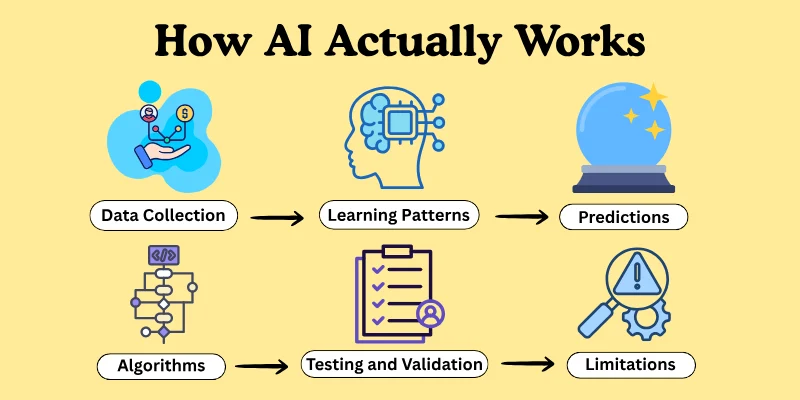
Let’s take a look at them one by one.
1. Data Collection
AI begins its work by collecting information from the real world. This information can come from websites, sensors, user activity, images, or written content. Good-quality input helps systems understand situations more clearly and produce reliable results.
Poor or biased input leads to weak outcomes, even if the system looks advanced. That is why companies now focus more on accurate, diverse, and updated sources than ever before.
2. Learning Patterns
After collecting information, AI studies it to find meaningful connections. It compares examples, spots similarities, and separates differences. This process helps the system understand how things relate to each other.
Instead of remembering facts, it builds understanding through repeated exposure. With enough examples, it starts recognizing trends that humans might miss due to scale or speed.
3. Predictions
Once learning is complete, AI uses its understanding to act. It selects answers, ranks options, or predicts what might happen next. Each action depends on previous learning and current input.
The system does not guess randomly; it follows learned rules based on probability. This ability allows AI to support tasks like search results, fraud checks, and language understanding.
4. Algorithms
Algorithms guide AI on how to process information. They define what the system should focus on and how it should compare inputs. Different tasks require different rule sets. Some focus on sorting, while others focus on recognition or prediction.
These rules help AI remain consistent and controlled. Well-designed logic also prevents random behavior and ensures predictable results across similar tasks.
5. Testing and Validation
AI goes through testing. This step checks how well it performs with new and unseen information. Testing helps identify weaknesses before real-world use.
Validation ensures the system behaves fairly and accurately across different scenarios. Strong testing reduces the risk of failure when real users rely on the system.
6. Limitations and Boundaries
AI works within clear limits. It cannot understand emotions or intent as humans do. It depends fully on the information and rules provided. Recognizing these boundaries helps users trust AI for the right tasks and avoid unrealistic expectations. Awareness of limits prevents misuse and overreliance on automated systems.
Types of AI Technology
AI technology comes in different forms, and each type solves problems in its own way. These technologies help machines understand data, learn from experience, and respond to real-world situations. Here are some main types of AI technology.
- Machine Learning: Machine learning allows systems to learn from data and improve through experience. It helps AI identify patterns and make decisions without manual rules. Many modern applications rely on this method to adapt over time.
- Deep Learning: Deep learning uses layered structures inspired by the human brain. It processes large amounts of information to handle complex tasks. This approach works well for speech recognition, image analysis, and advanced predictions.
- Natural Language Processing: Natural language processing helps AI understand and respond to human language. It enables systems to read text, listen to speech, and generate meaningful replies. This technology supports translation, search, and conversation systems.
- Computer Vision: Computer vision allows AI to interpret visual information from images and videos. It helps machines detect objects, recognize faces, and analyze scenes. Many industries use this technology for security, healthcare, and automation.
AI systems often combine more than one of these technologies to work effectively. Each type plays a specific role, depending on the task and environment. Together, they form the foundation of modern artificial intelligence.
How AI Works Through AI Tools
When AI moves from learning to real use, people often interact with it through tools designed to simplify complex tasks. These tools take the heavy work behind the scenes and present results in an easy-to-understand way. This allows anyone to benefit from AI without deep technical knowledge.
- Input and Instructions: AI begins working when users provide clear input, like text, images, or commands. When I first tried AI tools like ChatGPT, I noticed it could summarize text in seconds, which made me realize how powerful even simple input can be. Well-defined instructions help the system respond accurately.
- Processing in the Background: AI analyzes information using learned patterns. This process happens automatically and quickly. Users only see the result, while all calculations remain behind the scenes. Tools like Google Cloud AI, Hugging Face, and IBM Watson manage large-scale processing for businesses and developers.
- Output and Results: AI delivers actionable results, such as text suggestions, summaries, or recommendations. These outputs save time and make complex tasks manageable. Users should still review results to ensure correctness and relevance. Tools like Canva AI for design, Runway ML for visuals, and Lumen5 for video content make outputs easy to use.
- Feedback and Continuous Improvement: When users adjust or refine AI outputs, the system learns and improves future responses. Regular interaction strengthens performance and helps align results with real-world needs. Many tools, like ChatGPT and Bard, adapt based on user feedback to improve accuracy over time.
AI tools make advanced technology accessible while keeping the core AI process unchanged. Proper use and careful review ensure reliable, helpful outcomes every time.
Conclusion
In this guide, we have covered how AI works. You’ve learned the basic process and how it applies to everyday tools. My advice is to explore slowly and keep track of what works best for you. By reviewing your results and adjusting carefully, you can manage everything smoothly. Thank you for staying with me through this guide, and I hope it gave you a useful understanding.
Check out the FAQs below for a quick answer. There’s more interesting information waiting for you, so stay tuned.
FAQs
Let’s go through some quick FAQs that people often ask about how AI works. Each answer gives you a clear and easy explanation.
AI works by learning from information and finding patterns. It studies examples and improves through practice. Once trained, it gives results based on what it learned. AI does not think like humans. It follows logic built into the system.
Developers create AI by combining data, rules, and learning methods. They start with a goal and collect relevant information. The system learns through repeated testing. Developers adjust it until results improve. This process takes time and planning.
AI coding means writing instructions that help machines learn from data. It tells the system how to process information. Coders test and improve these instructions regularly. The goal is accuracy, not perfection. Good coding reduces mistakes.
AI programs vary based on what they are designed to do. Some handle text, others focus on images or numbers. Each program solves a specific type of problem. Developers choose programs based on needs. No single program fits all tasks.
AI cannot function without data. Data helps it learn and improve. Without examples, it cannot recognize patterns. More useful data leads to better results. Quality matters more than quantity.
Start with basic guides and simple examples. Try using beginner-friendly tools to see how AI responds. Focus on understanding input and output. Learn gradually without pressure. Small steps build confidence.
No, AI is a broad concept. Machine learning is a part of AI. Machine learning focuses on learning from data and improving over time. AI can also include rule-based systems. Not all AI systems use machine learning.





- Be Respectful
- Stay Relevant
- Stay Positive
- True Feedback
- Encourage Discussion
- Avoid Spamming
- No Fake News
- Don't Copy-Paste
- No Personal Attacks
- Be Respectful
- Stay Relevant
- Stay Positive
- True Feedback
- Encourage Discussion
- Avoid Spamming
- No Fake News
- Don't Copy-Paste
- No Personal Attacks
