10 AI Data Analytics Tools That Transform Business Decisions
Published: 8 Apr 2026
AI data analysis tools are transforming how businesses process and interpret large datasets by automating insights, reducing manual effort, and improving decision-making speed. With AI-powered analytics tools, users can now automate tasks, detect patterns, and generate insights within seconds.
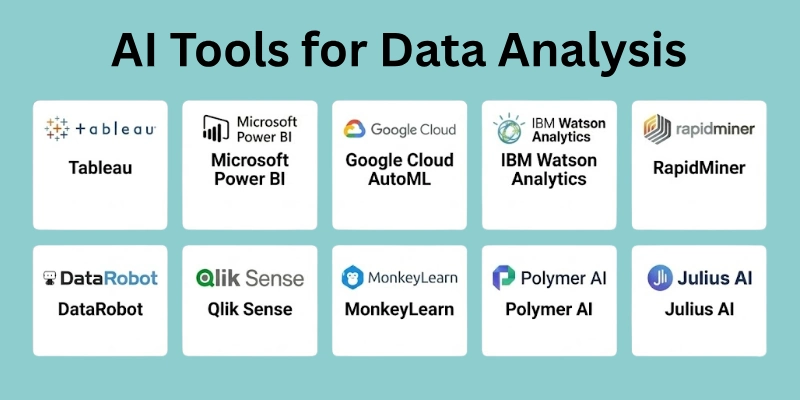
Companies rely on these tools to improve accuracy and make faster decisions based on real-time data. I have explored several platforms for reporting, trend analysis, and data visualization. They consistently deliver better results compared to manual data processing.
In this article, we explore the best AI tools for data analysis that help improve efficiency, accuracy, and overall productivity.
Best AI Tools for Data Analysis
With so many options available today, choosing the right tool can feel overwhelming. Here are some of the top AI data analysis tools that help turn complex datasets into meaningful insights.
1. Tableau
Tableau is a powerful platform that helps users turn raw data into meaningful visuals without much effort. It simplifies complex datasets through interactive charts and dashboards that are easy to understand.
Many professionals rely on it for reporting because it connects smoothly with different data sources. Its drag-and-drop interface speeds up analysis, even for users with limited technical skills.
Core Features
- Interactive dashboards with real-time updates
- Drag-and-drop data visualization tools
- Integration with multiple data sources
- Advanced analytics and reporting options
Best for: Professionals who need clear, interactive dashboards for data insights
2. Microsoft Power BI
Businesses widely use Power BI to transform their data into detailed reports and visual dashboards. It helps users track performance, identify trends, and share insights across teams.
The platform works well with other Microsoft tools, making it a strong choice for organizations already using that ecosystem. Its reporting features make decision-making more structured and data-driven.
Standout Features
- Real-time data monitoring and dashboards
- Seamless integration with Microsoft tools
- Custom report creation with visual insights
- AI-powered data analysis capabilities
Best for: Businesses looking for complete business intelligence and reporting solutions
3. Google Cloud AutoML
Google Cloud AutoML makes machine learning accessible without requiring coding knowledge. It allows users to build models that can analyze data, detect patterns, and make predictions.
The platform handles complex processes in the background, so users can focus on results instead of technical details. It is especially useful for teams that want scalable AI solutions.
Key Capabilities
- No-code machine learning model creation
- High-quality prediction and accuracy
- Support for text, image, and data analysis
- Cloud-based scalability for large datasets
Best for: Users who want simple access to machine learning for data analysis
4. IBM Watson Analytics
IBM Watson Analytics offers advanced capabilities for analyzing large and complex datasets. It uses natural language processing, allowing users to ask questions and get insights quickly. The platform is designed for enterprise-level use where accuracy and security are critical. It helps organizations uncover hidden patterns and make informed decisions.
Notable Features
- Natural language data queries
- Automated insights and recommendations
- Strong data security and governance
- Advanced visualization tools
Best for: Large organizations handling complex and sensitive data.
5. RapidMiner
RapidMiner is known for its strong data science and analytics capabilities. It allows users to build workflows for data preparation, modeling, and analysis without writing code. The platform is flexible and supports a wide range of data sources.
It is commonly used by analysts who need detailed insights from structured and unstructured data.
Feature Highlights
- Drag-and-drop workflow creation
- Data preparation and cleaning tools
- Predictive analytics and modeling
- Integration with multiple data sources
Best for: Data analysts working on complex and detailed projects.
6. DataRobot
DataRobot focuses on automating the process of building and deploying machine learning models. It helps users analyze data patterns and generate predictions quickly.
The platform reduces the time required for model development, making it easier for businesses to adopt AI. It is widely used for forecasting and performance analysis.
Platform Features
- Automated machine learning model building
- Fast prediction and forecasting tools
- Easy model deployment and monitoring
- Real-time analytics capabilities
Best for: Businesses that need quick predictive insights without manual modeling
7. Qlik Sense
Qlik Sense provides a flexible environment for exploring and visualizing data. It allows users to interact with dashboards and discover insights through simple clicks.
The platform encourages data exploration by offering smart suggestions and connections between datasets. It is useful for teams that want more control over their analytics process.
Top Features
- Interactive and customizable dashboards
- AI-powered data suggestions
- Self-service data exploration tools
- Flexible reporting and visualization
Best for: Teams that want dynamic and interactive data exploration
8. MonkeyLearn
MonkeyLearn specializes in analyzing text-based data such as reviews, feedback, and customer messages. It helps users extract meaning from large volumes of text without manual effort.
The platform uses AI to classify, organize, and interpret information quickly. It is especially helpful for businesses that rely on customer insights.
What It Offers
- Sentiment analysis for customer feedback
- Text classification and tagging
- Keyword extraction from large datasets
- Easy integration with apps and tools
Best for: Businesses working with customer feedback and text data.
9. Polymer AI
Polymer AI turns spreadsheets into interactive dashboards without requiring coding skills. It simplifies the process of analyzing and presenting data by automatically generating insights.
Users can upload data and instantly get visual reports that are easy to understand. Its simple interface makes it suitable for beginners and small teams.
Main Features
- No-code dashboard creation
- Instant data visualization and insights
- Easy data filtering and segmentation
- Quick setup with minimal effort
Best for: Beginners who want simple and fast data analysis solutions.
10. Julius AI
Julius AI brings a different approach by allowing users to analyze data through chat-based commands. Instead of using complex tools, users can simply ask questions and receive insights instantly.
It makes data analysis more accessible for non-technical users. The platform is useful for quick analysis and simple reporting tasks.
Core Capabilities
- Chat-based data analysis system
- Instant insights from simple queries
- Support for multiple file formats
- Easy-to-use interface
Best for: Users who prefer analyzing data through simple conversations instead of complex tools.
Real-World Use Cases of AI in Data Analysis
Different industries widely apply AI-powered solutions to enhance efficiency and facilitate smarter decision-making.
- Marketing teams gain insights into customer behavior and campaign performance
- Financial professionals forecast trends and manage risks more effectively
- Healthcare providers analyze patient records to improve treatment outcomes
- E-commerce businesses track sales patterns and enhance customer experience
These examples highlight how AI simplifies complex data processes and delivers valuable insights across various sectors.
Challenges and Limitations of AI Data Analysis Tools
AI-powered data analysis tools bring speed and automation, but they are not completely free from drawbacks. While they improve efficiency, users still need to understand their limitations before relying on them for critical decisions.
- Data privacy and security risks can arise when handling sensitive business or customer information
- Some advanced platforms require time and practice to fully understand and use effectively
- Premium tools often come with high subscription costs, especially for enterprise-level features
- The accuracy of insights depends heavily on the quality and structure of the input data
Being aware of these factors helps users choose the right tool and apply it more responsibly in real projects.
Conclusion
AI data analysis tools have made it much easier to handle large and complex datasets without deep technical effort. They streamline data processing, uncover patterns, and turn raw information into clear, actionable insights. From automation to predictive analytics, these tools help reduce manual workload and improve accuracy across every stage of analysis.
Overall, using AI-powered analytics solutions can significantly boost productivity and decision-making. As data continues to grow in every industry, adopting these tools is becoming essential for staying efficient, competitive, and data-driven.
FAQs
The section below covers frequently asked questions about AI data analysis tools.
They are used to process large datasets, identify patterns, and generate meaningful insights. These tools help users make faster and more informed decisions with less manual effort.
Yes, many platforms are designed with simple interfaces and no-code features. Beginners can analyze data without needing advanced technical or programming skills.
Most modern tools support real-time processing and live dashboards. This allows users to monitor updates and trends as data changes.
Some tools offer free versions, while advanced features require paid plans. Pricing usually depends on features, usage, and team size.
Yes, they provide accurate insights that help businesses understand trends and performance. This leads to more data-driven and strategic decisions.
Many AI analytics platforms are no-code or low-code. However, advanced tools may offer coding options for more profound customization.
Trusted platforms follow strong security protocols to protect user data. Still, it is important to review privacy policies before use.
They are widely used in marketing, finance, healthcare, e-commerce, and tech industries. Any field that works with data can benefit from them.
Yes, most tools are built to process and analyze large volumes of data efficiently. They maintain performance even with complex datasets.
They reduce human errors by automating calculations and validating data inputs. This ensures more consistent and reliable results.




- Be Respectful
- Stay Relevant
- Stay Positive
- True Feedback
- Encourage Discussion
- Avoid Spamming
- No Fake News
- Don't Copy-Paste
- No Personal Attacks
- Be Respectful
- Stay Relevant
- Stay Positive
- True Feedback
- Encourage Discussion
- Avoid Spamming
- No Fake News
- Don't Copy-Paste
- No Personal Attacks
