Perplexity AI vs. ChatGPT: Which AI Tool Is Better in 2026?
Published: 9 Apr 2026
Artificial intelligence tools are rapidly changing how people search, write, and learn online. From students to marketers, everyone is now relying on smart assistants to save time and improve productivity. Two popular names leading this shift are Perplexity AI and ChatGPT.
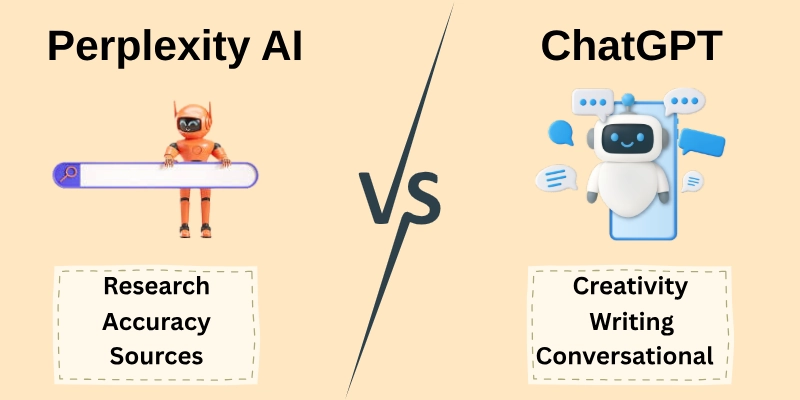
But choosing between them is not always simple. Both tools offer powerful capabilities, yet they serve different purposes. If you are confused about which one fits your needs, this guide will help you make a clear decision.
In this detailed comparison of Perplexity AI vs. ChatGPT, you will discover their features, differences, use cases, and pricing to find the right option for your workflow.
What is ChatGPT?
ChatGPT is an advanced AI chatbot developed to generate human-like text. It can help with writing, coding, brainstorming ideas, and even solving complex problems in simple language.
One of the biggest strengths of a conversational AI tool is its ability to understand context and respond conversationally. Whether you want to write blog posts or get help with technical tasks, it adapts easily.
Key Highlights
- Natural conversation experience
- Strong content creation abilities
- Supports coding and problem-solving
- Flexible across multiple industries
What is Perplexity AI?
Perplexity works more like a smart search engine than a chatbot. It focuses on delivering accurate answers backed by real-time data and credible sources.
Instead of long conversations, it provides concise responses with citations. This makes it especially useful for research and fact-checking tasks.
Key Highlights
- Real-time web access
- Source-based answers
- Clean and simple interface
- Strong focus on accuracy
Key Differences: Perplexity AI VS ChatGPT
Perplexity AI vs ChatGPT differ mainly in how they handle information, interaction, and real-world use cases. These differences often decide which tool feels more useful depending on your workflow.
Here are the key differences between them.
- Purpose and Function
- Accuracy and Reliability
- Content Creation Ability
- Research and Information Gathering
- User Experience
- Real-Time Data Access
Let’s explore each in detail.
1. Purpose and Function
These AI tools use artificial intelligence, but their core purposes are unique.
- ChatGPT: Designed for conversation and content generation. It works like a virtual assistant that helps with writing, coding, brainstorming, and explaining ideas. You can interact with it naturally and refine responses step by step. Best suited for creative and productivity tasks.
- Perplexity AI: Focused on answering questions with facts and sources. It behaves more like an AI search engine that delivers concise, reference-backed responses. Instead of long conversations, it aims to provide direct and reliable information. Ideal for quick answers and factual queries.
2. Accuracy and Reliability
When decisions depend on correct information, accuracy becomes essential.
- ChatGPT: Provides detailed explanations but may occasionally generate incorrect or outdated information. While it is improving, it does not always include sources by default. Suitable for general knowledge but requires manual verification for critical tasks.
- Perplexity AI: Pulls data from live sources and shows citations with each response. This makes it easier to verify details and trust the output. It performs well for updated and fact-based queries. A strong option for users who need dependable answers.
3. Content Creation Ability
The difference becomes clear when you ask both tools to write something.
- ChatGPT: Excels in writing blogs, scripts, emails, and marketing content. It understands tone, structure, and creativity, which makes the output feel natural and engaging. A wonderful choice for anyone working in content creation or communication.
- Perplexity AI: Focuses on short, informative responses rather than long-form writing. It can help gather ideas, but it is not built for storytelling or detailed content production. It is more effective in providing information than in fostering creativity.
4. Research and Information Gathering
For research-heavy tasks, both tools take different approaches.
- ChatGPT: Explains topics in depth and makes complex ideas easier to understand. However, it may not always provide direct references unless prompted. More useful for learning concepts rather than verifying sources.
- Perplexity AI: Provides quick answers along with source links, which helps users cross-check information easily. It simplifies research by combining search results into one clear response. Ideal for academic work and fact-checking.
5. User Experience
The way you interact with each platform feels quite different.
- ChatGPT: Offers a conversational interface where you can ask follow-up questions and refine answers. The experience feels interactive and flexible. Great for users who prefer a dialogue-based approach.
- Perplexity AI: Uses a clean, search-style interface that delivers answers quickly. There is less back-and-forth, which makes it efficient for simple queries. Suitable for users who want immediate results without extra interaction.
6. Real-Time Data Access
Access to current information can impact how useful a tool is.
- ChatGPT: Can access recent data depending on the version and features enabled. While it can provide updated information, it may not always match the real-time consistency of search-based tools. Works well for general tasks rather than live updates.
- Perplexity AI: Always connected to the web, providing up-to-date information with every query. This makes it reliable for news, trends, and recent developments. A solid choice for time-sensitive searches.
Use Cases: Which Tool Should You Choose?
Different users have different needs, and both tools serve specific purposes depending on the task. Choosing the right one becomes easier when you look at how each fits into real-world use. Let’s break down which tool works best for different types of users.
- For Students: Students who need accurate references for assignments will find Perplexity AI more useful. It helps with quick research and reliable answers.
- For Content Writers: Writers benefit more from ChatGPT because of its ability to generate detailed and engaging content. It is widely used as an AI writing assistant for blogs and articles.
- For Researchers: For deep research tasks, the AI search engine tool provides better support with citations and real-time insights.
- For Digital Marketers: ChatGPT is a better option for marketing tasks such as ad copy, email campaigns, and content strategy. Many professionals use it as an AI content generator to speed up workflows.
- For Everyday Users: If you need quick answers, Perplexity AI is a helpful resource. For more interactive tasks, the AI chatbot tool offers a better experience.
Pros and Cons of ChatGPT
ChatGPT is widely used for writing, learning, and problem-solving tasks. While it offers flexibility and creativity, it also has a few limitations to keep in mind. Here’s a balanced look at its strengths and weaknesses.
Pros
- Strong ability to create engaging and detailed content
- Works across multiple tasks like writing, coding, and learning
- Conversational style makes interaction smooth and flexible
- Adapts tone and structure based on user needs
Cons
- Can sometimes provide incorrect or outdated information
- Does not always include sources for verification
- Responses may require editing for factual accuracy
- Performance depends on prompts and instructions
Pros and Cons of Perplexity AI
Perplexity AI focuses on accuracy and delivering source-backed answers for users who need reliable information. It performs impressively in research tasks, but it may not suit every type of workflow. Here’s a clear breakdown of its advantages and drawbacks.
Pros
- Delivers accurate answers with clear source references
- Provides real-time information for updated queries
- Simple interface for quick and focused searching
- Helpful for research and fact-checking tasks
Cons
- Limited ability to generate long-form creative content
- Less interactive compared to conversational tools
- Responses are often short and less detailed
- Not ideal for storytelling or marketing content
Pricing Comparison
Cost plays an important role when choosing between these two tools, especially if you plan to use them daily. Both platforms offer free access, but their paid plans unlock more advanced capabilities and better performance.
ChatGPT Pricing
AI chatbot provides a free plan that covers basic usage, including general writing, idea generation, and simple tasks. It works well for beginners who want to explore an AI chatbot for productivity without spending money.
The paid plan, known as Plus, costs around $20 per month. It provides access to faster responses, improved models, and better performance during peak times. This plan is suitable for professionals who rely on an AI writing assistant for consistent output.
Perplexity AI Pricing
Perplexity AI also offers a free version that allows users to search, explore topics, and get answers with sources. It is a beneficial starting point for those who need an AI research tool for everyday queries.
The Pro plan is priced at about $17 per month. It includes advanced AI models, deeper search capabilities, and improved response quality. This option is useful for users who need more detailed insights and frequent research support.
Note: Pricing plans may change over time, so it’s always best to check the official websites of both tools for the latest updates and features.
Conclusion
In this guide, we explored the Perplexity AI vs. ChatGPT differences in detail. I discussed each tool’s task approach, daily use, features, pricing, and user benefits.
Both tools are powerful in their own way, but the right choice depends on what you need most. From my experience, if your work involves creativity and writing, go with ChatGPT. If you rely more on accuracy and verified information, Perplexity AI will suit you better.
Make sure you don’t skip the next FAQs section. You might find useful answers that can help you make a better decision.
FAQs
These are some of the most commonly asked questions about the Perplexity AI vs. ChatGPT.
It works well as a daily AI chatbot because it helps with writing, ideas, and general problem-solving. It is more flexible for everyday productivity compared to Perplexity AI.
Perplexity AI is a strong AI search engine that provides direct answers with sources, making research faster. However, it still works best alongside traditional search tools for deeper exploration.
This AI tool is generally more reliable for factual information because they provide citations with answers. ChatGPT is useful for explanations but may need fact-checking in some cases.
It is widely used as an AI writing assistant for blogs, emails, and social media content. It helps create structured and engaging text quickly.
Yes, Perplexity ai works as a real-time research assistance tool that pulls updated data from the web. This makes it useful for news, trends, and recent events.
GPT offers a conversational experience that feels natural and straightforward to navigate. Perplexity AI is simpler in a search format but less interactive.
The right choice depends on your needs, so here’s a quick way to decide:
- Choose ChatGPT for writing, ideas, and creative tasks
- Choose Perplexity AI for research and accurate answers
- Use both together for better results in content and research
Perplexity AI offers a free version with basic features for everyday queries. Additionally, it offers advanced research capabilities through a paid plan.
ChatGPT is more effective for SEO content creation because it can generate long-form articles and optimized text. It helps in structuring content for better readability and ranking.
Yes, many users combine both tools for better results in AI research and writing. Perplexity AI helps gather facts, while ChatGPT turns them into polished content.





- Be Respectful
- Stay Relevant
- Stay Positive
- True Feedback
- Encourage Discussion
- Avoid Spamming
- No Fake News
- Don't Copy-Paste
- No Personal Attacks
- Be Respectful
- Stay Relevant
- Stay Positive
- True Feedback
- Encourage Discussion
- Avoid Spamming
- No Fake News
- Don't Copy-Paste
- No Personal Attacks
