AI Prompt Engineering Guide: Types, Future, Uses & Career
Published: 22 Apr 2026
AI is growing fast, but many people still don’t know how to use it properly. Most people struggle to get good results from AI, not because of the tool, but because of how they communicate with it. That’s where prompt engineering changes everything. I’ve personally noticed that even small changes in a prompt can completely improve the results.
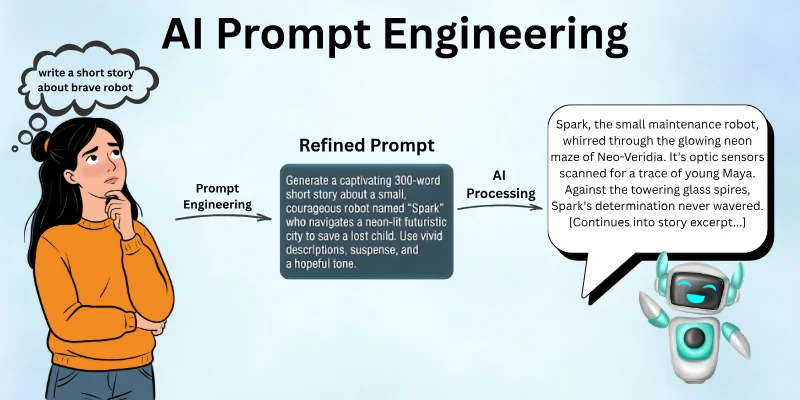
If you want better answers, stronger content, and real value from AI tools, prompt engineering is the skill you need to learn.
Let’s explore the AI prompt engineering guide step by step so you can start using it with confidence.
What is AI Prompt Engineering?
AI prompt engineering is the process of designing and refining inputs given to an AI system to get the best possible output.
In simple words, it means telling AI exactly what you want in a smart and structured way.
From a technical point of view, it involves understanding how AI models interpret language and adjusting your prompts to improve accuracy, relevance, and tone.
Think of it like giving directions. If your instructions are clear, you reach your destination easily. If they are vague, the result will not match your expectations.
How AI Prompt Engineering Works
AI tools work based on the instructions they receive. The quality of output depends heavily on how the input is written.
Here is how it works:
- You write a prompt (input)
- The AI processes your request using trained data
- It generates a response (output)
For example, a basic prompt like “write an article” will give a general result. But a detailed prompt like “write a 1000-word SEO article on digital marketing in simple English with examples” will produce a much better response.
This shows how important prompt structure is.
Why Prompt Engineering is Important
Prompt engineering plays a major role in improving the performance of AI tools.
It helps you:
- Get more accurate and relevant answers
- Save time by reducing edits
- Create high-quality content faster
- Improve productivity in daily tasks
For businesses, it also supports automation, better customer communication, and smarter decision-making.
Key Components of a Good AI Prompt
A well-written prompt goes beyond a simple question. It gives clear direction to the AI, so the output matches your expectations. When your input is structured properly, the response becomes more accurate, relevant, and useful.
- Clarity: Always use simple and direct language. Avoid complex or unclear wording that can confuse the AI. A clear instruction helps the system understand exactly what you want without guessing.
- Context: Adding background information improves the quality of the response. When the AI knows the purpose, audience, or situation, it can generate more meaningful and relevant content.
- Specificity: Be precise about your requirements. Instead of giving general instructions, define details like topic, format, length, or goal. This reduces errors and gives you a more targeted result.
- Tone and Style: Mention how you want the response to sound. Whether you need a professional tone, casual writing, or something engaging, specifying this helps match the output to your needs.
- Constraints: Setting clear limits improves control over the response. You can define word count, structure, or any restrictions that guide the AI to stay within your expectations.
Types of AI Prompts
Different prompt styles help you control how AI responds. Choosing the right type can improve accuracy, structure, and overall output quality.
1. Zero-shot prompts
This method works without giving any examples. You simply ask a question or give an instruction, and the AI responds based on its training.
Example: “Write a short blog intro about digital marketing trends.”
This approach is quick and useful for general tasks, but results may vary depending on how clear your input is. It is commonly used in AI content generation when speed matters.
2. One-shot prompts:
In this method, you provide one example to guide the response. It helps the AI understand the expected format or style.
Example: “Example: ‘SEO helps websites rank higher on search engines.’
Now write a similar line about social media marketing.”
This works well when you want a consistent tone or structure, especially in AI writing tools.
3. Few-shot prompts
Here, you include multiple examples to train the AI within the prompt. This improves accuracy and keeps the response aligned with your expectations.
- Example 1: ‘Email marketing builds customer relationships.’
- Example 2: ‘Content marketing drives organic traffic.’
Now write a similar line about influencer marketing.”
This method is useful in prompt design techniques where consistency and pattern matching are important.
4. Instruction-based prompts
These prompts focus on clear and direct commands. You tell the AI exactly what to do.
Example: “Write a 500-word article on the benefits of remote work in simple English.”
This is widely used in AI productivity tools because it gives structured and goal-oriented results.
5. Role-based prompts
This technique assigns a role to the AI, so it responds from a specific perspective.
Example: “Act as a professional SEO expert and suggest 5 keyword ideas for a fitness blog.”
This approach improves depth and relevance, especially in advanced prompt engineering tasks where expertise matters.
Best Practices for Effective Prompt Engineering
To get better results from AI, follow these proven strategies:
- Write clear and direct instructions to avoid confusion and improve output accuracy in AI content creation
- Break complex tasks into smaller steps so the AI can handle each part more effectively
- Use proper structure, such as headings or bullet points, to guide responses in SEO content writing
- Be specific about requirements like tone, length, and format for better prompt optimization
- Provide enough context so the AI understands the purpose and target audience
- Refine and test different prompt variations to improve results over time in AI writing tools
- Avoid vague or overly complex language that can reduce output quality
- Keep instructions focused and relevant to get more precise responses from AI productivity tools
Tools Used for Prompt Engineering
Various platforms support prompt creation and refinement, making it easier to generate better AI responses across different tasks.
- AI writing assistants help produce articles, blogs, and marketing content with improved accuracy.
- Chat-based AI platforms allow real-time interaction and quick response generation.
- Workflow automation tools streamline repetitive tasks and enhance productivity.
- Prompt libraries offer ready-made ideas and templates for faster execution
- Experimentation platforms enable users to test and refine inputs for better performance
These solutions make it easier to improve output quality while saving time and effort.
Prompt Engineering vs Traditional Programming
Prompt engineering is different from traditional coding.
In programming, you write strict rules using code. In prompt engineering, you communicate using natural language.
Key differences:
- Coding requires syntax knowledge
- Prompting focuses on communication skills
- Programming builds systems
- Prompting guides AI behavior
Both skills are valuable and often work together.
Is Prompt Engineering a Good Career in 2026?
Prompt engineering is emerging as a strong career path in 2026 as more industries depend on AI-driven solutions for daily work. Businesses are actively seeking individuals who can effectively communicate with AI systems to improve productivity, content quality, and automation processes.
At the same time, freelancers are building income opportunities by offering services in areas like content creation, digital marketing, and workflow automation using prompt-based skills. With the rapid expansion of artificial intelligence across different sectors, the demand for people who understand how to craft effective prompts is expected to grow steadily in the coming years.
Future of AI Prompt Engineering
The future of prompt engineering looks strong as AI continues to develop across industries. Even though AI tools are becoming more advanced and capable, human guidance will still play an important role in shaping accurate and useful outputs.
The way people interact with AI systems is expected to change over time, becoming more natural, efficient, and integrated into daily workflows.
Some key trends include:
- More advanced AI models with a better understanding of context and intent
- Smarter automation tools that reduce manual effort in tasks
- Greater focus on creativity and human input to improve output quality
Learning prompt engineering today can give you a clear advantage in the future job market and digital work environment.
Conclusion
In this guide, I explained the AI prompt engineering guide in a simple and practical way so you can understand how it shapes the way we interact with AI tools. It is the skill of giving clear and structured instructions to get better, more accurate, and useful results from artificial intelligence systems.
As AI continues to grow, this skill is becoming more valuable for students, professionals, writers, and businesses. Learning it can improve productivity, strengthen creativity, and help you use AI more effectively in real-world tasks.
By practicing and refining your prompts, you can unlock the true potential of AI tools and stay ahead in the digital world.
FAQs: AI Prompt Engineering Guide
Prompt engineering is the skill of giving clear instructions to AI tools to get better results. It helps improve accuracy, structure, and relevance in outputs. This concept is widely used in AI prompt engineering techniques for better performance.
It is important because it improves how effectively we use AI tools in daily tasks. Better prompts lead to better answers, saving time and effort. It plays a key role in modern AI content creation workflows.
No, coding is not required to learn prompt engineering. It mainly depends on communication and logical thinking skills. Many people use it in AI writing tools without technical backgrounds.
It works by guiding AI through structured input so it understands the task clearly. The system then generates output based on that instruction. This process is essential in the usage of AI productivity tools.
Yes, it helps create more structured and keyword-focused content for search engines. Well-written prompts can improve ranking potential and readability. It is commonly used in SEO content writing strategies.
It is used in writing, coding, marketing, and customer support automation. Businesses rely on it to improve efficiency and output quality. It is a key part of AI automation processes.
Yes, it is becoming a popular skill as AI adoption increases worldwide. Companies and freelancers both use it for better results. It is growing fast in AI career opportunities.
Yes, it will remain important even as AI becomes more advanced. Human guidance is still needed for accurate and meaningful outputs. It will continue shaping the future of AI-driven content creation.


- Be Respectful
- Stay Relevant
- Stay Positive
- True Feedback
- Encourage Discussion
- Avoid Spamming
- No Fake News
- Don't Copy-Paste
- No Personal Attacks
- Be Respectful
- Stay Relevant
- Stay Positive
- True Feedback
- Encourage Discussion
- Avoid Spamming
- No Fake News
- Don't Copy-Paste
- No Personal Attacks
