Ahrefs Review: I Tested It for Months; Here Is the Truth
Published: 20 Sep 2026
Every serious SEO conversation eventually leads to one name: Ahrefs. It comes up when people talk about finding keywords, analyzing competitor backlinks, fixing technical issues, and now even tracking visibility inside AI search results. But popularity does not automatically mean value for your specific situation.
So I spent months testing Ahrefs across real content projects, keyword campaigns, and competitor research workflows. This Ahrefs review breaks down everything I found, including what the tool genuinely does well, what frustrated me, and whether the price is actually justified.
What Is Ahrefs?
Ahrefs is an all-in-one SEO platform built specifically for organic search growth. It started as a backlink analysis tool in 2011 and has since grown into a complete suite that covers keyword research, competitor analysis, technical site auditing, rank tracking, content research, and AI visibility monitoring.
What separates Ahrefs from most SEO tools is the size and freshness of its data. Its web crawler is the second most active on the internet after Google, which means the backlink index, keyword database, and traffic estimates it produces are far more reliable than what most competing tools can offer.
The platform stays focused. Unlike Semrush, which expanded into PPC, social media, and content marketing tools, Ahrefs is built purely around organic search. That is its biggest strength and, depending on what you need, its main limitation.
How Ahrefs Works
Ahrefs continuously crawls the web and collects data from billions of pages. This data powers every tool inside the platform.
When you use Ahrefs, you are working with:
- A backlink index is updated every 15 to 30 minutes
- A keyword database covering 10+ search engines
- Traffic estimates built from real ranking data
- Site health reports based on full technical crawls
- AI visibility data pulled from live AI search platforms
The platform does not guide you through SEO step by step. It gives you data and expects you to know how to use it. That is an important distinction before you subscribe.
Ahrefs Review: Features Explained
Ahrefs includes seven core tools, each designed for a specific part of the organic SEO workflow. Here is a detailed breakdown of every feature I tested.
1. Site Explorer
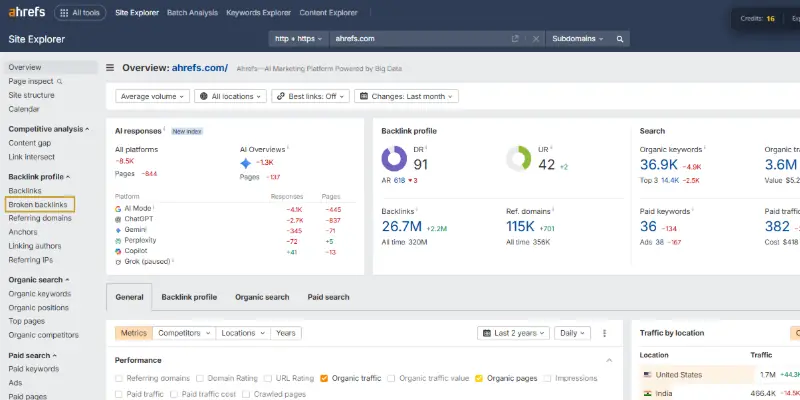
Site Explorer is the most powerful feature in the platform and the one I open most often. Enter any domain or URL and get a full picture of that site’s organic traffic, keyword rankings, backlink profile, and paid search activity in seconds.
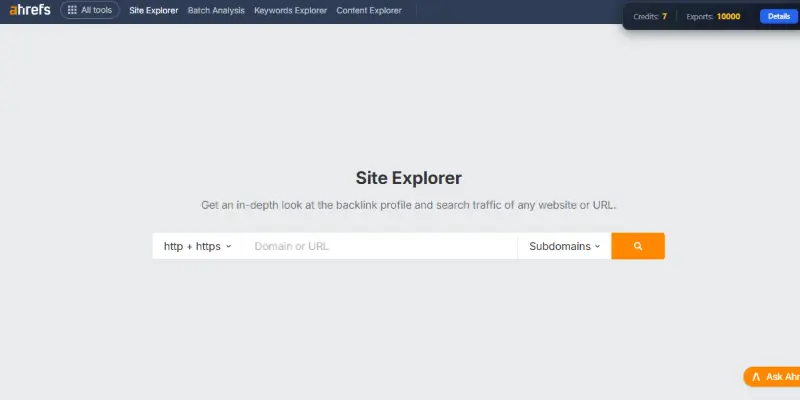
The key metrics inside Site Explorer include:
- Domain Rating (DR): A score representing the overall strength of a site’s backlink profile
- Estimated organic traffic: Monthly visitor estimate based on keyword rankings and click rates
- Total referring domains: Number of unique websites linking to the domain
- Anchor text distribution: Breakdown of how external sites describe the target in their links
- Traffic value: Estimated cost to replicate the organic traffic through Google Ads
The traffic value metric is particularly useful for client reporting. It shows non-technical stakeholders the actual business impact of organic SEO in a number they immediately understand.
2. Keywords Explorer
Keywords Explorer covers keyword research across more than 10 search engines, with Google as the primary database. Enter any topic, and you get search volume, keyword difficulty, click-through rate data, traffic potential, and hundreds of related keyword ideas organized by topic cluster.
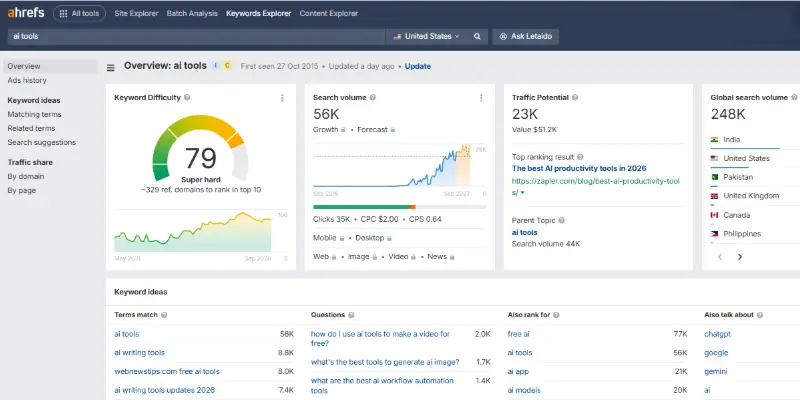
The standout features inside this tool are the following:
- Keyword Difficulty (KD): Calculated from referring domains to top-ranking pages, not abstract authority scores
- Traffic Potential: Total traffic the top-ranking page earns across all related keywords it ranks for
- Parent Topic: Identifies whether you can rank for a keyword by optimizing an existing page
- SERP overview: Shows actual ranking pages with their DR, backlinks, and traffic side by side
- Questions filter: Surfaces question-format queries for featured snippet and FAQ targeting
3. Site Audit
The Site Audit tool crawls your entire website and produces a health score alongside a prioritized list of technical issues to fix. It checks for more than 100 on-page and technical SEO factors.
Issues that commonly surface, including the following:
- Broken internal and external links
- Redirect chains and redirect loops
- Duplicate content across pages
- Missing or duplicate title tags and meta descriptions
- Thin or low-word-count pages
- Slow-loading URLs
- Crawlability and indexation problems
- Core Web Vitals issues
Every flagged issue comes with a plain-English explanation and a specific action step. Audits can be scheduled to run automatically daily, weekly, or monthly, so you always have current data.
4. Rank Tracker
Rank Tracker monitors your keyword positions across Google and Bing for any country, region, city, or device type. You can track keyword movements over custom date ranges, filter by SERP feature presence, and segment performance by tag.
The most useful addition in 2026 is AI Overview detection. Rank Tracker now shows which of your tracked keywords trigger an AI overview in Google results, which is critical because AI overviews absorb significant click share from traditional organic listings. Knowing which pages are affected helps you prioritize content improvements.
One thing to note: daily rank tracking is not included in standard plans. It requires a paid add-on, which adds to the total monthly cost.
5. Content Explorer
Content Explorer lets you search through a database of more than 14 billion web pages to find the best-performing content on any topic. You can filter results by organic traffic, referring domains, social shares, publish date, word count, and domain rating.
Most useful for:
- Building targeted link prospecting lists from pages linking to similar content
- Finding content gaps that your competitors are targeting, but you are not
- Spotting trending topics before they become saturated in your niche
- Identifying guest posting and digital PR opportunities
Content Explorer is only available on the Standard plan and above. This is one of the main practical reasons Standard is a better starting point than Lite for anyone doing serious content strategy or link-building work.
6. Brand Radar (AI Visibility Tracking)
Brand Radar is the most forward-looking addition Ahrefs has made in recent years. It tracks how often your brand or any topic appears inside AI-generated search responses.
Platforms currently tracked include:
- Google AI Overviews
- Google AI Mode
- ChatGPT
- Perplexity
- Gemini
- Microsoft Copilot
- Grok (added April 2026)
The tool pulls data from a database of over 200 million real search-backed prompts. Inside the dashboard, you can view share of voice over time, see which domains get cited most often in AI answers, and compare your AI visibility against competitors.
As a still-maturing feature, Brand Radar has documented accuracy limitations for some platforms, particularly ChatGPT. The full AI index tracking also comes as a paid add-on on top of your base subscription. Despite those caveats, no other all-in-one SEO platform offers anything close to this level of AI visibility monitoring right now.
7. Ahrefs Webmaster Tools (Free)
Even without a paid subscription, verified site owners can access Ahrefs Webmaster Tools at no cost. It includes:
- Full Site Audit with no URL limit
- Complete backlink data for your verified domains
- Organic keyword rankings for which your site appears
- Privacy-friendly web analytics showing traffic by source, including AI chatbots
The web analytics inside AWT specifically show you which AI platforms like Gemini, Perplexity and ChatGPT are sending traffic to your site right now. As AI referral traffic grows as a measurable channel, that data is increasingly worth tracking.
For new bloggers or small business owners monitoring their own site, Ahrefs Webmaster Tools consistently outperforms paid tools in the $30 to $50 per month range.
Who Should Use Ahrefs?
Ahrefs works best for people who are already doing SEO with intention. If your website depends on organic traffic and you make regular decisions about keywords, content, and links, this tool will save you enormous amounts of time.
It is a strong fit for:
- SEO professionals and consultants who need accurate, trustworthy data for client work
- Content marketers who research keywords and competitors before publishing
- Link builders who need fresh, reliable backlink data for prospecting
- Bloggers and niche site owners where organic traffic is the main growth strategy
- Agencies managing multiple client websites with different reporting needs
Who Should Avoid It?
Not every website owner needs Ahrefs, and buying it before you are ready is a waste of money.
You should skip Ahrefs for now if:
- You are a complete beginner still learning what backlinks and keyword difficulty mean
- You run paid ad campaigns and need PPC data in the same platform
- Your budget cannot comfortably cover $129 per month for the entry professional plan
- You publish one or two articles per month with no serious traffic goals
- You only need to monitor your own site, because free Webmaster Tools already covers that
My Experience Using Ahrefs
I tested Ahrefs across keyword research, backlink analysis, technical auditing, and competitor research over several months. Here is what actually happened.
Setup and First Impressions
The signup is quick, and the dashboard feels clean. Ahrefs keeps navigation simple with five core tools on the left sidebar. There is no guided onboarding, so the platform assumes you already know your way around SEO. Experienced users will feel at home immediately. Beginners may need a week or two before things click.
Did Organic Traffic Actually Improve?
Yes, but not because of Ahrefs alone. Using it helped me make smarter decisions about keywords, content gaps, and link-building priorities. One article I had been struggling to rank for years moved from page three to page one after I used Site Explorer to find the exact backlink gap between my page and the top competitor, then closed that gap.
A separate cluster of posts improved after the site audit flagged weak internal linking. Fixing those connections brought a noticeable traffic bump across that topic group within six weeks.
Ahrefs gave me the right information. The results came from acting on it correctly.
What I Liked Most
- Backlink data freshness: Updates every 15 to 30 minutes, faster than any other tool I tested
- Keyword difficulty accuracy: Based on actual referring domain counts, not abstract scores
- Link Intersect: Built a 40-site outreach list in one session that would have taken a full day manually
- Site Audit clarity: Every issue is explained in plain English with a specific fix step
- Free Webmaster Tools: Genuinely powerful without spending anything
Biggest Frustrations
- No PPC data: Paid campaign analysis requires a separate tool
- Learning curve: The first two weeks feel steep without prior SEO experience
- Daily rank tracking costs extra: Should be included at the base plan level
- Expensive for beginners: $129 per month is a real barrier for early-stage sites
Ahrefs Pricing Plan
Ahrefs launched a new Starter plan in early 2026 at $29 per month, cutting the entry cost significantly compared to previous years. Here is the full pricing breakdown.
| Plan | Monthly Price | Annual (per month) | Projects | Tracked Keywords |
|---|---|---|---|---|
| Starter | $29 | $29 | 1 | Not included |
| Lite | $129 | $108 | 5 | 750 |
| Standard | $249 | $208 | 20 | 2,000 |
| Advanced | $449 | $374 | 50 | 5,000 |
| Enterprise | Custom | From $1,249 | 100 | Custom |
Annual billing saves approximately 16.67%, which is around two months free over the full year.
Is There a Free Trial?
No. Ahrefs discontinued its trial offer years ago and has not brought it back. The lowest-risk way to evaluate the platform before spending is through Ahrefs Webmaster Tools, which is permanently free for verified site owners. If you want to test paid features, the $29 Starter plan is the most affordable entry point.
Is Ahrefs Worth the Price?
For websites where organic traffic drives real business results, yes. The data quality justifies the cost when you are making regular decisions about keywords, content, and links that have financial consequences.
For hobby blogs or early-stage sites still finding their direction, the price is harder to justify. In that case, start with the free Webmaster Tools and revisit the paid plans once organic SEO is a genuine priority.
Pricing verified as of September 2026. Always confirm current plans on the official Ahrefs website before subscribing.
Ahrefs Pros and Cons
Here are the benefits and limitations of Ahrefs.
| ✅ Pros |
|---|
|
| ❌ Cons |
|---|
|
Ahrefs vs Competitors
Several strong SEO tools compete for the same budget. Here is how Ahrefs compares against each major alternative.
Ahrefs vs Surfer SEO
This is one of the most common comparisons people make, and it is also one of the most misunderstood. Ahrefs and Surfer SEO are not direct competitors. They solve different problems inside the same SEO workflow.
Ahrefs is built for strategy. It tells you which keywords to target, which competitors to study, and which backlinks to earn. Surfer SEO is built for execution. It guides you while you write and helps individual pages score better against what is currently ranking.
For a detailed breakdown of how these two tools work together, read the full Ahrefs vs Surfer SEO comparison. The short answer is that most serious content teams use both, not one or the other.
Ahrefs vs Moz
Moz helped define the concept of domain authority, but Ahrefs has significantly outpaced it over the past several years in both index size and feature depth. The Moz link database is smaller and updates less frequently. Moz is a reasonable starting point for complete beginners who find Ahrefs overwhelming, but working SEO professionals consistently choose Ahrefs when data accuracy actually matters.
Ahrefs vs Ubersuggest
Ubersuggest, at around $12 per month, is the most accessible option for solo bloggers just starting out with keyword research. The data is directional rather than precise, the backlink database is much smaller, and there is no equivalent to Site Explorer for real competitive intelligence. For hobbyists on a tight budget, it works. For anyone doing professional SEO, the gap in data quality is too large to ignore.
What Real Users Say About Ahrefs
Across G2, Capterra, and Trustpilot, Ahrefs holds a consistent average rating of 4.6 out of 5. Recurring praise centers on backlink data reliability, keyword difficulty accuracy, and the overall trustworthiness of the information the platform surfaces.
The most common criticism is pricing. The 2023 price increases drew significant frustration across Reddit’s r/SEO community, and the additional cost of add-ons like daily rank tracking and the Brand Radar AI index bundle continues to come up in reviews from users who expected a more complete base offering.
The general consensus among experienced SEO practitioners in 2026 remains consistent: if organic search is your primary growth channel, Ahrefs is the most trustworthy data investment in the market. If you also need paid search analytics or white-label reporting, Semrush usually gets recommended as a companion or alternative.
Final Verdict: Ahrefs Review
Ahrefs has been the benchmark for serious SEO data for years, and after months of testing it across real campaigns and content projects, that reputation holds up.
The backlink index is still the best available outside of Google. The keyword difficulty scoring is still the most actionable in the industry. The site audit tool explains technical problems clearly enough for anyone to act on. And Brand Radar now gives it a genuine advantage in AI visibility tracking that no competing all-in-one platform has matched.
Is it expensive? Yes. Is the learning curve real? Absolutely. But for bloggers scaling toward serious organic traffic, agencies managing client results, and SEO professionals whose income depends on accurate data, Ahrefs consistently pays for itself.
If cost is a concern before committing, start with the free Webmaster Tools. The data quality there is identical to what paid plans offer for your own domain. Once you see it firsthand, the decision whether to upgrade becomes straightforward.
FAQs
Here are the most common questions people ask before or after reading an Ahrefs review, answered as clearly as possible.
Yes, for websites where organic traffic drives real results. The backlink data, keyword difficulty accuracy, and Brand Radar AI visibility tracking make it the most reliable SEO platform available right now
Indirectly, yes. It gives you the data to make better decisions about keywords, content gaps, and backlinks. It does not guarantee rankings, but the insights directly inform the actions that move pages up.
It can be, but there is a real learning curve. The platform assumes you already understand core SEO concepts, so most new users need two to three weeks before they feel comfortable.
- Powerful data available from day one
- Requires some existing SEO knowledge to use effectively
For organic SEO, it replaces most separate tools for backlink research, keyword discovery, rank tracking, and technical auditing. It does not replace:
- Content optimization tools like Surfer SEO for on-page writing guidance
- PPC platforms, if you run paid search campaigns
For early-stage sites, the $129 per month Lite plan is hard to justify. The free Webmaster Tools covers most monitoring needs until organic SEO becomes a genuine priority.
Test data quality before committing. The $29 Starter plan is the lowest-risk paid entry point. Ahrefs Webmaster Tools is permanently free for verified site owners and is the best way to
Three things: the size and freshness of its backlink index, the accuracy of its keyword difficulty scoring, and Brand Radar’s AI visibility tracking across seven platforms.
Yes. Ahrefs handles research and strategy, while Surfer SEO handles on-page content optimization. Together, they cover the full SEO workflow.
- Use Ahrefs to find keyword opportunities and analyze competitors
- Use Surfer SEO to optimize individual articles while writing






- Be Respectful
- Stay Relevant
- Stay Positive
- True Feedback
- Encourage Discussion
- Avoid Spamming
- No Fake News
- Don't Copy-Paste
- No Personal Attacks
- Be Respectful
- Stay Relevant
- Stay Positive
- True Feedback
- Encourage Discussion
- Avoid Spamming
- No Fake News
- Don't Copy-Paste
- No Personal Attacks
