Pros and Cons of Artificial Intelligence (AI)
Published: 14 Jan 2026
Today, more than half of businesses worldwide use artificial intelligence in daily work, from writing emails to analyzing data. I use AI tools every day, and I see real gains and real problems at the same time.
That is why understanding the pros and cons of AI matters more than ever. AI saves time and boosts accuracy, but it also raises concerns about jobs, privacy, and trust. Ignoring either side leads to poor decisions.
In this article, we will clearly explore how AI helps, where it fails, and what it means for real people and real work.
Pros of Artificial Intelligence
AI helps people work faster, make better decisions, and solve problems that once took hours or days. This shows why understanding the benefits of AI is important for everyone today.
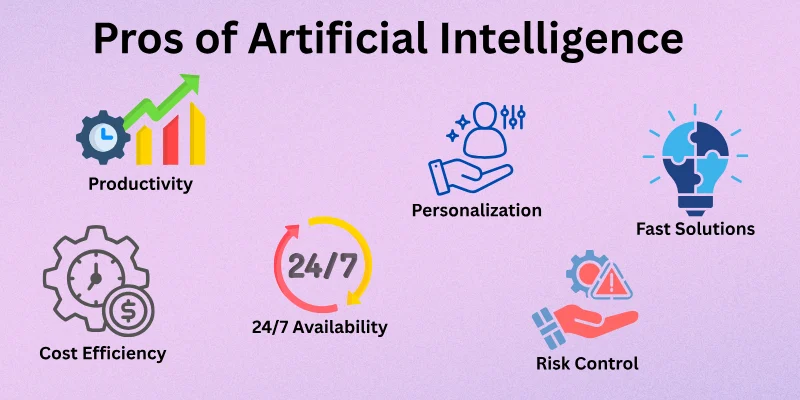
Here is the list of all the advantages of AI.
- Increased Efficiency and Productivity
- Smarter Decisions
- Better Personalization
- Improved Accuracy
- 24/7 Availability
- Cost Efficiency
- Personalized Experience
- Fast Solutions
- Risk Control
- Easy Scaling
Let us learn about AI strengths in detail.
1. Increased Efficiency and Productivity
AI helps people complete tasks faster and with better focus. It handles repetitive work that usually wastes time and energy. Many industries use AI to reduce delays and improve daily output.
AI processes information quickly and keeps work moving without interruptions. This allows teams to focus on creative and strategic tasks. As a result, overall productivity increases across different sectors.
- Automates repetitive daily work tasks.
- Speeds up routine business processes.
- Reduces manual effort and delays.
- Handles large workloads consistently well.
2. Smarter Decisions
AI supports better decision-making by analyzing large amounts of data. It identifies patterns that humans often miss. Businesses use AI to predict outcomes and reduce guesswork.
AI tools provide accurate insights based on real-time information. This leads to confident and informed choices. Better decisions help organizations avoid costly mistakes.
- Analyzes data faster than humans.
- Finds patterns people often miss.
- Supports informed business planning decisions.
- Reduces guesswork in key decisions.
3. Better Personalization
AI improves personalization by understanding user behavior and preferences. It adjusts content and services based on individual needs. Many platforms use AI to deliver relevant suggestions and experiences.
This creates stronger engagement and satisfaction. Personalized systems feel more useful and efficient. Users receive what they need without extra effort.
- Customize user recommendations instantly.
- Adapts content to user behavior.
- Improves engagement through experiences.
- Enhances satisfaction with tailored interactions.
4. Improved Accuracy
AI improves accuracy by processing data with precision and consistency. It follows rules without distraction or fatigue. AI systems reduce human mistakes in calculations and analysis. Many industries rely on AI to detect errors early.
AI also improves results by learning from past data. It delivers stable outcomes even with complex inputs. This accuracy supports better planning and execution.
- Fewer calculations and data errors.
- Consistent results every time.
- Reliable pattern recognition.
- Strong data validation support.
5. 24/7 Availability
AI systems work continuously without breaks or downtime. They provide instant responses at any time of day. Businesses use AI to support users across time zones. AI tools maintain the same performance level at all hours. This availability improves service reliability and speed. It also reduces delays in critical tasks. Continuous operation increases overall efficiency.
- Always active support systems.
- No fatigue or downtime.
- Faster response at night.
- Global time zone coverage.
6. Cost Efficiency
AI helps reduce long-term operational costs. It automates tasks that require manual labor. Businesses save money on repetitive processes.
AI also lowers error-related expenses. It improves resource use through smarter decisions. Over time, AI delivers strong financial value. Cost control becomes easier with automation.
- Reduced labor-related expenses.
- Lower operational overhead costs.
- Fewer costly human errors.
- Better resource usage planning.
7. Personalized Experience
AI improves how people interact with digital systems by adapting to individual needs. It studies behavior, preferences, and past actions to deliver relevant content. This makes services feel more useful and less generic.
Users receive recommendations that match their interests and goals. Businesses use this ability to increase satisfaction and engagement. Personalization also helps users save time and effort.
- Custom content for each user.
- Smarter product recommendations.
- Improved user satisfaction levels.
- Adaptive learning and services.
8. Fast Solutions
AI solves complex problems at high speed by processing large data sets quickly. It detects patterns that humans may miss. This helps organizations respond faster to challenges and opportunities.
AI reduces delays in analysis and decision cycles. Quick solutions improve efficiency across many industries. Speed also supports better planning and execution.
- Rapid data analysis capability.
- Quick pattern recognition.
- Reduced problem resolution time.
- Faster decision execution.
9. Risk Control
AI helps identify risks before they cause damage. It monitors data continuously to spot unusual activity. This allows early action against threats and errors.
Industries like finance and healthcare use AI to reduce losses. AI also improves accuracy in risk assessment. Better risk control leads to safer operations.
- Early threat detection systems.
- Continuous data monitoring.
- Improved risk assessment accuracy.
- Reduced financial and operational losses.
10. Easy Scaling
AI supports growth without reducing performance quality. Systems handle increasing workloads without human limits. This helps businesses expand operations smoothly.
It adapts to higher demand with minimal delay. Scaling becomes cost-effective and manageable. Organizations grow faster with fewer disruptions.
- Handles growing workloads easily.
- Maintains consistent performance levels.
- Supports rapid business growth.
- Reduces scaling-related costs.
Cons of Artificial Intelligence
While AI offers plenty of advantages, it also has some downsides. People can become overly dependent on machines, and AI sometimes makes errors or decisions that are hard to explain.
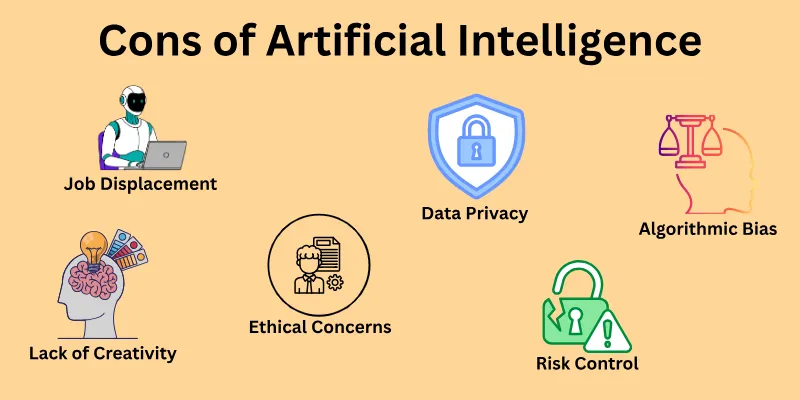
Here, I have mentioned some major limitations that I personally feel.
- High Implementation Costs
- Job Displacement
- Lack of Creativity
- Dependence on Data
- Data Privacy Issues
- Ethical Concerns
- Algorithmic Bias
- Security Vulnerabilities
- Unpredictable Errors
- Lack of Common Sense
Let us examine the disadvantages of AI in detail.
1. High Implementation Costs
AI can save time and improve efficiency, but setting it up is costly. Many businesses need to spend on software, hardware, and skilled professionals. Small companies often struggle to afford these tools.
High costs can limit AI access to only large organizations. Over time, the investment can pay off, but the initial spending is a major barrier.
- Expensive software and hardware.
- Skilled professionals needed.
- Continuous updates are required.
- The initial setup is very costly.
2. Job Displacement
AI can automate tasks that humans do daily. This automation sometimes replaces employees in repetitive or manual jobs. People in factories, offices, and customer service face these changes.
While AI creates new roles, some workers feel insecure about the future. Managing workforce transitions becomes a challenge for many companies.
- Repetitive jobs are at risk.
- Manual roles were replaced.
- Employee uncertainty grows.
- Workforce adjustment is needed.
3. Lack of Creativity
AI follows patterns and data, so it cannot truly invent new ideas. It can suggest improvements or variations, but original thinking comes from humans. This limitation affects art, writing, and problem-solving.
People still need to guide AI to produce meaningful results. Creativity cannot be fully automated or predicted by machines.
- Cannot generate original ideas.
- Follows existing patterns only.
- Human input remains crucial.
- Limited artistic innovation.
4. Dependence on Data
AI works only when it has access to large amounts of data. If the data is incomplete or incorrect, AI cannot perform well. Many businesses rely heavily on AI decisions, which can be risky. Over-dependence can reduce human critical thinking. People still need to check AI results carefully.
- Requires large datasets.
- Results need verification.
- Performance drops with errors.
- Humans must oversee output.
5. Data Privacy Issues
AI collects and analyzes personal information to work effectively. This can raise serious privacy concerns. Sensitive data may get exposed or misused if not protected. Companies need strict rules to handle information safely. Privacy risks can affect trust between users and businesses.
- Personal user data is at risk.
- Sensitive information may get exposed.
- Possible misuse of user information.
- Trust and confidence may decline.
6. Ethical Concerns
AI can make decisions that affect people’s lives. Without proper guidance, it may act unfairly or create bias. People worry about AI being used in harmful ways. Laws and ethical rules often lag behind technology. Responsible use requires careful monitoring and clear policies.
- Decisions may often be unfair.
- Risk of biased AI actions.
- Harmful or dangerous use is possible.
- Proper ethical oversight is required.
7. Algorithmic Bias
AI learns from the data we give it. If the data contains biases, AI can make unfair decisions. This affects hiring, lending, law enforcement, and more. Biased AI can damage trust and reputation.
People may receive unequal treatment without realizing it. Businesses must constantly review AI to reduce bias. Proper monitoring helps prevent serious consequences.
- AI reflects biased input data.
- Decisions may unfairly affect people.
- Review AI regularly for fairness.
- It can harm the company’s reputation.
8. Security Vulnerabilities
AI systems are targets for hackers and cyberattacks. Breaches can cause data loss or misuse. Malware can manipulate AI decisions. Organizations need strong cybersecurity to protect AI.
Without proper safeguards, small flaws can lead to large problems. Security weaknesses can create financial and reputational damage. Businesses must stay alert at all times.
- AI systems face hacking threats.
- Sensitive data may get stolen.
- Malware can manipulate AI behavior.
- Security updates must be constant.
9. Unpredictable Errors
AI can make mistakes even with good data. Sometimes it gives wrong results that humans do not expect. These errors can cause financial, operational, or safety problems.
People must check AI outcomes carefully. Mistakes may remain unnoticed for long periods. Even minor errors can lead to bigger consequences.
- AI may produce unexpected mistakes.
- Wrong results can cause issues.
- Human review prevents serious problems.
- Mistakes may affect business decisions.
10. Lack of Common Sense
AI cannot think like humans or apply common sense. It follows patterns and rules strictly. This can lead to illogical or impractical decisions. Humans must intervene to correct these actions. AI cannot predict unusual or unique situations. Common sense remains critical in decision-making. AI still cannot fully replace human judgment.
- AI cannot use common sense.
- May make illogical decisions.
- Human guidance remains necessary.
- Cannot fully replace judgment.
Use Cases of AI
Artificial intelligence supports many tasks that people handle every day. It helps improve speed, accuracy, and decision quality across different fields. Businesses and individuals use AI to simplify work and solve complex problems efficiently.
- Healthcare Diagnostics: Assists doctors by detecting diseases through scans and reports.
- Customer Support Systems: Handles user queries using automated chat and response tools.
- Financial Fraud Detection: Identifies unusual transactions to prevent financial loss.
- Personalized Marketing: Delivers targeted content based on user behavior.
- Autonomous Vehicles: Enable self-driving features and traffic awareness.
- Smart Assistants: Perform voice-based tasks like reminders and searches.
- Manufacturing Automation: Improves production flow and quality checks.
- Education Platforms: Supports adaptive learning and student performance tracking.
- Cybersecurity Monitoring: Detects threats and protects digital infrastructure.
- Supply Chain Optimization: Improves inventory planning and demand forecasting.
- Language Translation: Converts text and speech between languages.
- Content Recommendation: Suggests videos, music, or products to users.
These use cases show how AI fits into real-world environments. Each application solves a specific problem and adds practical value. As technology evolves, AI use cases will continue to expand across industries.
Ethical and Social Considerations of AI
Artificial intelligence now influences daily decisions that affect people and society. Its growing role raises important questions about fairness, responsibility, and long-term impact. Understanding these considerations helps ensure AI benefits humans without causing harm.
- Fair Decision Making: Ensuring automated systems treat all groups equally.
- Data Responsibility: Handling personal information with care and consent.
- Transparency Practices: Making system decisions easy to understand.
- Accountability Measures: Defining responsibility for automated outcomes.
- Social Impact Awareness: Studying effects on communities and culture.
- Human Control: Keeping people involved in critical decisions.
- Trust Building: Maintaining confidence between users and technology.
These considerations guide the safe and responsible use of AI across industries. Addressing them early helps create technology that supports society rather than disrupting it.
Conclusion
In this guide, we have covered the pros and cons of AI. It offers strong benefits, but it also brings challenges that need attention. We can manage these risks by using AI as a support tool, not a replacement for human thinking.
Training, awareness, and ethical use help create a healthy balance. Regular evaluation of AI outputs also helps reduce errors and misuse over time. Thank you so much for staying till the end, and I hope this guide helped you clearly.
Before you leave, take a moment to read the FAQs. There is more to learn there.
FAQs
Let’s explore some of the most common questions people ask about the pros and cons of AI.
Some people question why artificial intelligence is bad due to its risks. AI can replace repetitive jobs. It may also misuse data if not managed properly. These concerns grow when AI works without human checks.
- Job replacement fears.
- Data privacy risks.
- Lack of human judgment.
AI shows both helpful and harmful sides. AI improves productivity and accuracy. It can also create dependency if people rely on it too much. Understanding both sides leads to smarter use.
Many wonder why we need AI in modern systems. AI helps companies analyze large data quickly. It improves decision-making and customer experience. Without AI, many industries would move more slowly.
AI affects education in many ways. AI supports personalized learning. It can also reduce critical thinking if overused. Students must use AI as a support tool, not a shortcut.
- Personalized study paths.
- Faster information access.
- Reduced independent thinking.
AI cannot fully replace humans. It lacks emotions, creativity, and moral judgment. Humans guide AI and correct its mistakes. It is best as a support system.
Managing AI risks requires responsible use. People must review AI results. Strict rules and transparency help reduce harm. Human involvement keeps AI safe and fair.
- Human review processes.
- Clear ethical guidelines.
- Strong data protection.
AI is generally safe when used responsibly and with proper controls. Risks arise when systems lack transparency or security. Regular monitoring and ethical use reduce most concerns. Safe usage depends on how humans design and manage AI systems.





- Be Respectful
- Stay Relevant
- Stay Positive
- True Feedback
- Encourage Discussion
- Avoid Spamming
- No Fake News
- Don't Copy-Paste
- No Personal Attacks
- Be Respectful
- Stay Relevant
- Stay Positive
- True Feedback
- Encourage Discussion
- Avoid Spamming
- No Fake News
- Don't Copy-Paste
- No Personal Attacks
