AI Customer Service Tools Every Business Should Use Now
Published: 2 Feb 2026
Why does customer support still feel slow when technology moves so fast? Many teams struggle to manage chats, calls, and emails at the same time. AI tools for customer service solve this by making support faster and more organized.
These systems handle common questions and give agents more time for complex issues. Support leaders notice lower costs and better customer feedback over time. Teams adapt quickly and feel more in control of daily work.
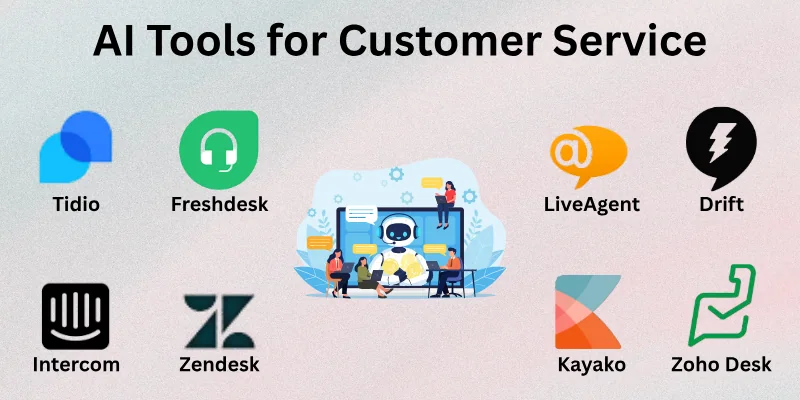
In this guide, I explain the 8 best AI-based customer service tools that improve support and streamline everyday operations.
Best AI Customer Service Tools
Handling customer support takes time, but AI tools make it faster and easier. They help manage chats, emails, and support requests without extra effort. Teams use them to respond quickly and stay organized.
Here are the best AI tools for customer service you can use right now.
- Tidio
- Freshdesk
- Intercom
- Zendesk
- Drift
- LiveAgent
- Zoho Desk
- Kayako
1. Tidio
Tidio helps businesses manage customer conversations in one place. It supports live chat and automated replies for common questions. The tool works smoothly on websites and online stores. Teams stay responsive without handling every message manually. Setup is quick and easy for daily support tasks.
Key features:
- Live chat with real-time visitor tracking.
- Automated chat flows for common queries.
- Integration with e-commerce platforms.
- Mobile app for on-the-go support.
Best for: Small businesses that need chat automation.
Pricing: Free plan available; paid plans start from around $29 per month.
2. Freshdesk
Freshdesk streamlines customer support with a unified ticketing system. It organizes emails, calls, and social media messages in a single dashboard. Agents can collaborate on complex issues without losing track. Automated workflows help prioritize urgent requests efficiently. The platform also provides insights to improve overall support performance.
Key features:
- Multi-channel ticket management.
- AI-powered automated responses.
- Collaboration tools for team efficiency.
- Analytics and reporting for performance tracking.
Best for: Growing teams that need organized support management.
Pricing: Free plan available; paid plans start at $23 per agent per month.
3. Intercom
Intercom provides a smart messaging platform for customer interactions. It delivers instant replies to common questions while allowing agents to handle complex issues personally. The system helps segment customers and send targeted messages. Teams can track conversations and follow up efficiently. Its flexibility makes it suitable for businesses of different sizes.
Key features:
- Automated messaging for quick responses.
- Customer segmentation for personalized support.
- In-app and email communication.
- Conversation tracking with follow-up reminders.
Best for: Companies that want personalized customer engagement.
Pricing: Starting at $39 per month for the essential plan.
4. Zendesk
Zendesk centralizes all customer inquiries in one platform for smooth support management. It helps teams respond quickly through email, chat, and social media. The system offers smart automation to assign tickets and reduce delays. Reporting features allow managers to track team performance and identify improvement areas. Its flexible setup fits businesses of any size.
Key features:
- Centralized ticketing across multiple channels.
- Workflow automation for faster responses.
- Performance analytics and dashboards.
- Customizable support workflows.
Best for: Teams needing scalable and structured customer service.
Pricing: Paid plans start at $25 per agent per month.
5. Drift
Drift focuses on real-time messaging to connect with customers instantly. It uses chatbots to qualify leads and answer simple questions automatically. Teams can hand off complex conversations to agents seamlessly. The platform also tracks visitor behavior to provide timely support. Its conversational approach helps improve engagement and satisfaction.
Key features:
- Real-time chat for immediate assistance.
- Lead qualification through automated bots.
- Smooth handoff to human agents.
- Visitor behavior tracking for proactive support.
Best for: Businesses aiming to boost engagement and convert visitors.
Pricing: free plan and paid plans are available.
6. LiveAgent
LiveAgent brings all customer interactions into a single interface for easier management. It allows teams to respond to emails, chats, calls, and social media messages without switching platforms. Automation features prioritize tickets and speed up responses. Agents can create knowledge base articles to reduce repeated questions. The platform also provides insights to improve workflow efficiency.
Key features:
- Unified inbox for all communication channels.
- Automated ticket prioritization.
- Knowledge base creation for self-service.
- Workflow analytics for better efficiency.
Best for: Support teams that handle multiple channels simultaneously.
Pricing: Free plan available; paid plans start at $15 per agent per month.
7. Zoho Desk
Zoho Desk helps teams manage customer queries efficiently across email, chat, and social media. It uses automation to assign tickets and reduce response delays. Agents can collaborate on complex issues without losing context. The platform also offers AI suggestions to improve answers. Reporting features track team performance and customer satisfaction over time.
Key features:
- Multi-channel ticket management.
- Automated ticket assignment.
- AI suggestions for faster resolutions.
- Performance and satisfaction reporting.
Best for: Teams that want an intelligent and collaborative support system.
Pricing: free plan available; paid plans are also available.
8. Kayako
Kayako offers a unified platform to manage customer conversations efficiently. It enables teams to provide support via email, live chat, and social media in one place. The system uses automation to route requests to the right agent quickly. Teams can track progress and resolve issues faster with built-in collaboration features. Its simplicity makes it suitable for small to mid-sized businesses.
Key features:
- Unified inbox for multiple channels.
- Automated request routing.
- Team collaboration tools.
- Progress tracking and reporting.
Best for: Businesses that want straightforward, multi-channel support.
Pricing: Paid plans available.
Why Businesses Need AI in Customer Service
Over the past few years, customer expectations have grown faster than ever. I’ve seen teams struggle to respond to high volumes of questions, and repetitive tasks can drain energy quickly. Today, AI tools make support smarter and more efficient, letting teams focus on what really matters.
- Faster Responses: Handle chats, emails, and calls instantly without keeping customers waiting.
- Reduce Workload: Automate routine queries so agents can focus on complex problems.
- Consistent Quality: Ensure every interaction meets a high standard.
- Scalable Support: Manage spikes in requests without adding extra staff.
- Data-Driven Insights: Analyze customer interactions to improve future service.
These tools save time, cut costs, and improve satisfaction. Small improvements in support workflow can make a noticeable difference in customer happiness.
Conclusion
In this guide, we explored the 8 best AI tools for customer service that help teams work faster and deliver better experiences.
These tools reduce response times and provide insights to improve service quality. Teams can scale support without adding extra staff, and customers get consistent, accurate help.
Using these tools has personally shown me how small improvements in workflow can make a big difference in customer satisfaction.
Overall, the right AI customer service tool empowers teams, enhances customer experience, and saves valuable time. By combining smart automation with thoughtful human support, businesses can create a service that truly stands out.
FAQs
Here are some frequently asked questions about AI tools for customer service.
Leading customer service software with AI includes platforms like Zendesk, Freshdesk, and Intercom. These solutions centralize tickets and provide automation for faster responses.
AI-powered customer service can handle repetitive questions automatically, prioritize tasks, and provide actionable insights, freeing agents to focus on high-value interactions.
Small businesses can use tools for support like Tidio, Drift, and Helpshift to manage emails, chats, and social media messages in one place efficiently.
Yes, AI-driven customer service reduces workload on agents, automates repetitive tasks, and improves efficiency, which ultimately lowers operational expenses.
AI-powered customer service chatbots answer common questions instantly, guide users through processes, and hand off complex issues to agents when needed.
Most modern AI tools are user-friendly and require minimal setup. Small teams can quickly integrate chatbots, automated ticketing, and analytics without technical expertise.
AI tools enhance human agents but cannot replace them entirely. Combining AI automation with human judgment ensures better quality and personalized customer service.





- Be Respectful
- Stay Relevant
- Stay Positive
- True Feedback
- Encourage Discussion
- Avoid Spamming
- No Fake News
- Don't Copy-Paste
- No Personal Attacks
- Be Respectful
- Stay Relevant
- Stay Positive
- True Feedback
- Encourage Discussion
- Avoid Spamming
- No Fake News
- Don't Copy-Paste
- No Personal Attacks
