Surfer SEO Review 2026: Is It Still Worth Paying For?
Published: 17 May 2026
Search engine optimization has changed dramatically over the last few years. Publishing random blog posts and hoping they rank doesn’t work anymore. Today, successful websites rely on data, search-intent analysis, topical authority, and content optimization tools to compete in crowded search results. One tool that continues to dominate the conversation is Surfer SEO.
So, is Surfer SEO actually worth using in 2026? To find out, I tested the platform across different content workflows, including blog optimization, AI-assisted writing, keyword clustering, and content audits. This Surfer SEO review covers everything you need to know before spending money on the tool.
What Is Surfer SEO?
Surfer SEO is a cloud-based SEO optimization platform designed to help websites create and improve content based on real search engine data.
Instead of guessing what Google wants, the platform analyzes top-ranking pages and provides recommendations related to:
- Content structure
- NLP keywords
- Heading usage
- Internal linking
- Search intent alignment
- Word count
- Topic coverage
The goal is to help writers create pages that are more aligned with what currently ranks in search results. Unlike traditional SEO tools that focus heavily on backlinks and technical audits, Surfer SEO specializes in on-page optimization.
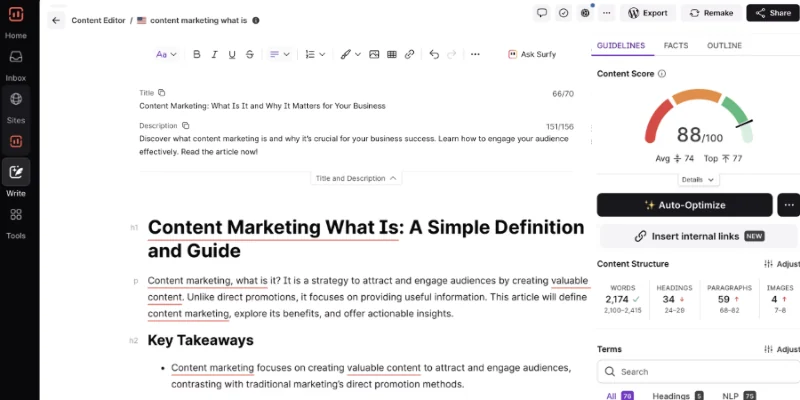
That makes it particularly popular among the following:
- Affiliate marketers
- Content marketers
- Bloggers
- SEO freelancers
- Content agencies
- AI-assisted publishing teams
How Surfer SEO Works
The platform starts by analyzing the top-ranking pages for your target keyword.
It then compares important ranking factors across those pages, including:
- Keyword placement
- Content depth
- Heading structure
- Semantic keyword usage
- Search intent signals
- Content freshness
Based on this analysis, Surfer SEO generates recommendations that writers can follow while creating or editing content.
One of its most popular features is the Content Editor.
This editor gives users a live optimization score while writing articles. As you add recommended terms and improve coverage, the score increases.
Who Should Use Surfer SEO?
Surfer SEO works best for people publishing content regularly.
If your strategy depends on ranking blog posts, building topical authority, or scaling SEO traffic, the platform can save a massive amount of time.
It is especially useful for:
Bloggers: Bloggers can use the tool to optimize informational content and improve search visibility.
Affiliate Marketers: Affiliate websites often target competitive buyer keywords. Surfer SEO helps identify missing terms and optimization opportunities.
SEO Agencies: Agencies managing multiple clients benefit from streamlined refinement workflows.
SaaS Companies: Software brands can use topical maps and keyword clustering to build authority around niche topics.
E-commerce Brands: Content-focused e-commerce stores can optimize category pages, guides, and informational content.
Who Should Avoid It?
Not everyone needs an advanced SEO optimization tool.
Surfer SEO may not be worth the cost if:
- You publish only one or two articles monthly
- Your site is brand new with minimal traffic
- You rely entirely on AI-generated content without editing
- You prefer manual SEO analysis
- Your content strategy is still experimental
For small hobby websites, the monthly subscription may feel expensive.
My Experience Using Surfer SEO
I tested Surfer SEO across multiple content types, including product reviews, informational blog posts, and content updates.
The experience was mostly positive, but there were also some frustrations worth discussing.
Setup and First Impressions
The onboarding process is straightforward. After creating a project, you can immediately start researching keywords or opening the content editor.
The dashboard feels modern and beginner-friendly. Most features are accessible from the left sidebar, making navigation simple even for first-time users.
Unlike some older SEO tools with cluttered interfaces, Surfer SEO keeps the workflow organized.
Creating the First Content Editor
The content editor is the core feature most people use. You enter a target keyword, choose a country, and let the platform analyze search results.
Within a few minutes, Surfer SEO generates recommendations related to:
- Word count
- Headings
- Questions
- NLP phrases
- Topic coverage
The editor updates in real time while writing. This makes optimization faster because you do not need separate spreadsheets or manual competitor analysis.
Using Surfer SEO With AI Writing Tools
One interesting area is combining Surfer SEO with AI writing platforms. Many users now pair it with tools like ChatGPT for faster content creation.
The workflow usually looks like this:
- Generate an outline
- Create a draft with AI
- Paste the content into Surfer SEO
- Optimize missing terms and structure
- Human-edit the article for quality and originality
This process can save hours. However, relying entirely on AI without proper editing often produces generic content.
Surfer SEO can improve topical coverage, but it cannot replace human experience, expertise, or creativity.
How Accurate Is the Content Score?
The content score system is useful, but it should not be treated as the ultimate ranking factor. In many cases, increasing the score improved article depth and keyword relevance.
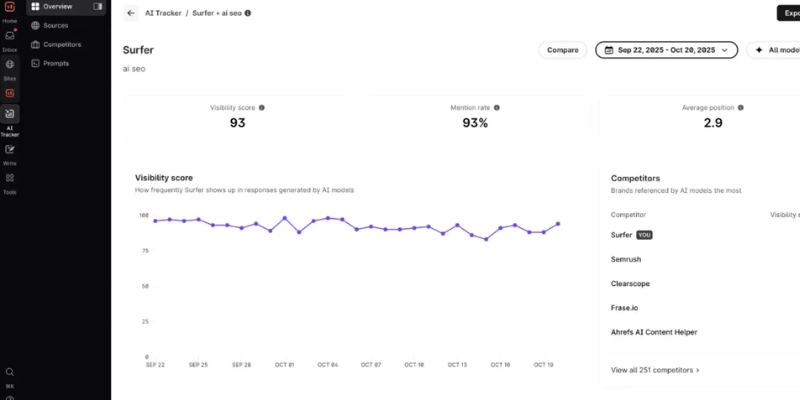
In some cases, I noticed that trying to push the refinement score too high actually made the article sound less natural. A few recommended phrases felt forced, so I had to balance SEO recommendations with readability. That is one of the biggest mistakes beginners make. Google does not rank pages simply because they have a high optimization score.
Search intent, user experience, originality, helpfulness, and backlinks still matter.
Did Rankings Actually Improve?
In competitive niches, optimized content generally performed better after using Surfer SEO recommendations. Updated articles gained better keyword coverage, stronger heading structure, and improved topical relevance.
For example, one informational article I updated moved from position 18 to page one after improving topic coverage and restructuring headings based on Surfer SEO recommendations. Another article gained better keyword visibility after fixing missing semantic terms suggested inside the content editor.
However, results varied depending on the following:
- Domain authority
- Competition level
- Search intent alignment
- Content quality
- Internal linking
- Backlink profile
Surfer SEO is not magic. It helps improve on-page SEO, but rankings still depend on broader SEO factors.
What I Liked Most
Several things stood out positively during testing.
- Fast Optimization Workflow: The platform dramatically reduces manual research time.
- Excellent Content Structuring: Heading recommendations help organize content effectively.
- Strong SERP Analysis: Competitor insights provide useful optimization directions.
- Helpful Topic Suggestions: The NLP recommendations often reveal missing subtopics.
- Great for Content Teams: Writers and editors can collaborate inside a structured workflow.
Biggest Frustrations
There were still a few limitations that stood out during testing. Here are some issues worth mentioning.
- Expensive for Beginners: Pricing may feel difficult to justify for small websites.
- Over-Optimization Risk: Chasing high scores can lead to robotic content.
- Keyword recommendations sometimes feel forced: Not every suggested phrase improves readability.
- AI Content Can Become Generic
- Without human editing, AI-assisted content often lacks originality.
Surfer SEO Review: Features Explained
Surfer SEO includes multiple tools designed to improve content optimization, keyword targeting, and topical authority.
Instead of relying on guesswork, the platform uses real SERP data to guide content decisions. This makes it easier for writers, bloggers, and SEO professionals to create pages that align with what currently ranks in Google.
Below is a detailed breakdown of the most important Surfer SEO features.
Content Editor
The Content Editor is the core feature inside Surfer SEO. Most users spend the majority of their time here because it acts as a live refinement workspace.
After entering a target keyword, Surfer SEO analyzes top-ranking pages and generates recommendations related to:
- Word count
- Headings
- NLP keywords
- Questions to answer
- Topic coverage
- Content structure
As you write, the optimization score updates in real time. This makes it easier to identify missing terms and improve topical relevance without manually analyzing competitor articles. One thing I liked about the content editor is how beginner-friendly it feels.
The recommendations are easy to understand, even for people with limited SEO experience. However, writers should avoid forcing every suggested keyword unnaturally.
SERP Analyzer
The SERP Analyzer studies the pages already ranking for your target keyword. This feature compares important SEO signals across competitor pages, including:
- Average word count
- Heading structure
- Keyword frequency
- Referring domains
- Page speed
- Partial keyword usage
The data helps users understand what successful pages are doing differently.
For example, if top-ranking articles consistently cover certain subtopics or use specific heading structures, Surfer SEO highlights those patterns.
This feature is extremely useful for competitive keywords where content depth matters. Instead of copying competitors manually into spreadsheets, users can analyze ranking pages within minutes.
Topical Map
A topical map is one of the most useful additions for modern SEO strategies. Google increasingly rewards websites that demonstrate niche authority.
Instead of publishing isolated articles randomly, websites now perform better when they cover related topics comprehensively.
The Topical Map feature helps users:
- Build topic clusters
- Discover supporting article ideas
- Plan content silos
- Strengthen topical authority
- Improve internal content relationships
This is especially valuable for:
- Niche websites
- SaaS blogs
- Affiliate marketing sites
- Authority publications
- Content-heavy businesses
For example, instead of targeting only one keyword like “email marketing software,” users can build an entire cluster around tutorials, comparisons, pricing guides, automation tips, and beginner resources.
This strategy helps websites establish stronger authority in search engines.
Audit Tool
The audit tool focuses on improving existing content. Rather than publishing endless new posts, users can refresh old articles and identify refinement opportunities.
The feature compares your page against current top-ranking competitors and highlights weak areas.
It checks factors such as the following:
- Missing keywords
- Thin topic coverage
- Weak headings
- Internal linking gaps
- Content freshness
- Meta-optimization
This feature works particularly well for websites that already have large content libraries. Many SEO professionals achieve faster ranking improvements by updating existing pages instead of constantly creating new ones.
For older blog posts that have lost traffic, the audit tool can reveal exactly what needs improvement.
Keyword Research
Surfer SEO also includes keyword research functionality.
Users can discover:
- Related search queries
- Search volume estimates
- Keyword clusters
- Search intent categories
- Content opportunities
The keyword clustering system is especially useful because it groups semantically related keywords. This helps users build content strategies focused on niche authority instead of isolated keywords.
While the keyword research feature is helpful, it is still not as advanced as dedicated platforms like Ahrefs or SEMrush.
However, for content-focused SEO workflows, it provides enough data for planning articles and topic clusters effectively.
Surfer AI
Surfer AI is the platform’s AI-assisted writing feature.
It can generate:
- Article outlines
- Introductions
- Headings
- Topic sections
- Full article drafts
This feature is designed to speed up content production. For agencies and content teams publishing multiple articles weekly, Surfer AI can save significant time.
However, the generated content still requires editing. Like most AI writing systems, the output sometimes feels generic and lacks the following:
- Personal experience
- Emotional depth
- Original opinions
- Real-world examples
- Industry expertise
The best approach is to use Surfer AI for drafting while manually improving readability, originality, and user engagement.
Internal Linking Features
Internal linking is an important ranking factor that many websites ignore. Surfer SEO includes internal linking suggestions designed to strengthen content relationships. The platform recommends pages that should link together based on topic relevance.
Strong internal linking can improve:
- User navigation
- Crawlability
- Topic relationships
- Authority distribution
- Time on site
For larger websites with hundreds of articles, these recommendations become extremely valuable. Good internal linking also helps search engines understand content structure more effectively.
Surfer SEO Pricing in 2026
Pricing remains one of the biggest concerns for potential users. Surfer SEO is not the cheapest SEO tool available, especially for beginners.
However, many businesses justify the cost because of the amount of time saved during improvement and content planning.
Standard Plan: This plan starts at around $99 per month/billed annually. It is designed for freelancers, bloggers, and smaller websites.
Scale Plan: The Scale plan costs around $182 per month/billed annually. It is designed for agencies, content teams, and websites publishing content at scale.
Enterprise Plan:
The enterprise plan starts at approximately $999 per month, with custom pricing available for larger organizations.
Which Plan Is Best?
Freelancers: Freelancers and solo writers can usually manage with the entry-level plan.
Bloggers: Bloggers publishing multiple articles monthly may benefit from a mid-tier subscription.
SEO Agencies: Agencies often need higher limits and collaboration features.
Enterprise Teams: Large organizations may require advanced workflows and custom integrations.
Is Surfer SEO Worth the Price?
For casual bloggers, the pricing may feel expensive.
For businesses generating revenue through organic traffic, affiliate marketing, or lead generation, the investment often becomes worthwhile.
If the platform helps improve rankings and increase traffic consistently, the ROI can justify the subscription cost.
Real Pros and Cons of Surfer SEO
Pros
- Surfer SEO removes the need for manual competitor analysis.
- The interface is modern, clean, and easy to navigate.
- The platform helps improve topical relevance and content depth.
- Content teams can optimize articles faster and maintain consistency.
- Competitor analysis provides valuable improvement guidance.
Cons
- Smaller websites may struggle to justify the monthly cost.
- Focusing too heavily on optimization scores can reduce readability.
- The platform focuses mainly on content refinement.
- Automation alone rarely creates exceptional content.
👉 Check Surfer SEO and see its features.
Does Surfer SEO Actually Improve Rankings?
This is the question most people care about. The answer is yes, but with limitations.
Surfer SEO improves on-page optimization and topical relevance, which can positively impact rankings.
However, rankings still depend on several other factors.
What Surfer SEO Does Well
The platform helps users:
- Cover missing subtopics
- Improve article structure
- Match search intent better
- Strengthen semantic relevance
- Create more comprehensive content
These improvements often lead to stronger SEO performance over time.
Where Surfer SEO Falls Short
The platform cannot:
- Build backlinks
- Increase domain authority
- Replace genuine expertise
- Guarantee rankings
- Create truly original insights
It is a supporting tool, not a complete SEO solution.
Why Optimization Scores Can Be Misleading
Many beginners obsess over reaching extremely high optimization scores. That is not always beneficial. Some high-ranking pages online do not have perfect refinement scores.
Google increasingly rewards:
- Helpful content
- Original perspectives
- Strong readability
- User satisfaction
- Real expertise
Stuffing keywords unnaturally often damages content quality.
What Google Rewards in 2026
Modern SEO focuses heavily on user-first content.
Google wants pages that:
- Solve problems clearly
- Match search intent
- Provide trustworthy information
- Deliver an excellent user experience
- Demonstrate expertise
Surfer SEO supports these goals when used properly. But it should never replace strategic thinking and quality writing.
Best Surfer SEO Alternatives
If Surfer SEO does not fit your budget or workflow, several alternatives are worth considering.
- Frase: Best for AI-assisted content creation.
- NeuronWriter: Best affordable refinement platform.
- Clearscope: Best premium content enhancement experience.
- MarketMuse: Best for enterprise-level content strategy.
- SEMrush Content Toolkit: Best for users already inside the SEMrush ecosystem.
Is Surfer SEO Good for AI Content?
AI-assisted publishing continues to grow rapidly in 2026. Many website owners now combine AI writing tools with optimization platforms. Surfer SEO fits naturally into this workflow.
Using ChatGPT With Surfer SEO
A common workflow looks like this:
- Generate an outline with AI
- Create a draft quickly
- Paste the article into Surfer SEO
- Optimize missing terms and structure
- Edit manually for quality and originality
This process saves time while maintaining strong optimization.
Can AI Content Rank?
Yes, but only when edited carefully. Google does not automatically penalize AI-generated content. The real issue is quality.
Low-quality AI content often:
- Repeats generic information
- Lacks originality
- Misses emotional nuance
- Provides shallow explanations
Human editing remains essential.
How to Avoid Over-Optimization
Important best practices include:
- Write naturally first
- Add keywords carefully
- Prioritize readability
- Focus on search intent
- Avoid stuffing phrases unnaturally
- Edit aggressively for clarity
Human Editing Best Practices
To improve AI-assisted content:
- Add personal insights
- Include examples
- Improve transitions
- Remove repetitive lines
- Fact-check all claims
- Simplify awkward phrasing
Articles usually perform better when they include real examples, opinions, and clearer human insight.
Final Verdict: Is Surfer SEO Worth It in 2026?
Surfer seo remains one of the strongest content optimization tools available today. It simplifies on-page SEO, speeds up content workflows, and helps publishers create more comprehensive articles.
The platform is especially valuable for:
- Bloggers
- Affiliate marketers
- SEO agencies
- SaaS companies
- Content-focused businesses
However, it is not a magic solution.
The biggest mistake users make is relying too heavily on optimization scores while ignoring content quality and user experience.
When combined with:
- Strong writing
- Search intent research
- Human editing
- Topical authority
- Effective internal linking
Surfer SEO can become a powerful part of a modern SEO strategy. If your goal is scaling high-quality content efficiently, the platform is absolutely worth considering.
FAQs: Surfer SEO Review
Let’s explore some frequently asked questions about Surfer SEO reviews.
Yes, Surfer SEO is still worth it in 2026 for users who focus on content-driven SEO strategies. It helps improve on-page SEO, content structure, and keyword relevance using real SERP data. However, results depend on how consistently you apply it with proper human editing and strategy.
Surfer SEO can help improve rankings indirectly by improving content quality, structure, and topical coverage. It does not guarantee rankings on its own but supports better optimization decisions. Strong backlinks, content depth, and user intent alignment are still very important for ranking success.
Yes, Surfer SEO is beginner-friendly because its interface is simple and recommendations are easy to follow. It removes guesswork by showing exactly what top-ranking pages include.
- Easy-to-use content editor
- Clear SEO suggestions based on real data
No, Surfer SEO cannot fully replace tools like Ahrefs or SEMrush. It mainly focuses on content optimization and SERP-based analysis rather than deep keyword discovery. It works best when used alongside dedicated keyword research tools.
- Strong for on-page SEO optimization
- Limited for advanced keyword research
For small websites or beginners, Surfer SEO can feel expensive depending on usage. If you publish limited content, the return on investment may take time. However, for growing sites, it can significantly improve workflow efficiency and content quality.
No, Surfer SEO does not guarantee top rankings in Google. It only improves on-page SEO factors based on competitor analysis and content structure. Other factors like backlinks, domain authority, and content quality still play a major role.
Surfer SEO mainly focuses on content optimization instead of being a full SEO suite. It provides real-time recommendations based on top-ranking pages, making it highly useful for writers and content teams. It is more content-focused compared to traditional SEO tools.
Yes, combining Surfer SEO with ChatGPT is a powerful workflow for faster content creation. ChatGPT helps generate drafts, while Surfer SEO improves optimization and structure.
- Faster content creation process
- Better SEO optimization with real SERP data






- Be Respectful
- Stay Relevant
- Stay Positive
- True Feedback
- Encourage Discussion
- Avoid Spamming
- No Fake News
- Don't Copy-Paste
- No Personal Attacks
- Be Respectful
- Stay Relevant
- Stay Positive
- True Feedback
- Encourage Discussion
- Avoid Spamming
- No Fake News
- Don't Copy-Paste
- No Personal Attacks
